
Ajrakh printing, a traditional block-printing craft known for geometric repeats, has its historical roots in Sindh, now in Pakistan, and important living traditions in Kutch, Gujarat, and Barmer, Rajasthan, according to IIT Bombay’s D’Source introduction and D’Source community account. Ajrakhpur is a modern centre founded after the 2001 earthquake, as Khamir’s craft history explains. When you shop for Ajrakh, distinguish the craft’s historical birthplace from the place where your garment was made.
Ajrakh print origin: understanding the regional map
Ajrakh’s geography connects Sindh, Kutch and Barmer through communities that continue to practise the craft. Within these regions, individual printing centres have their own histories.
Ajrakh’s regional connections
Sindh: historical roots and continuing craft, connected with practising communities in Kutch, Gujarat.
Within Kutch: Dhamadka, an established printing centre (Khamir’s adaptation accounts), and Ajrakhpur, a post-2001 centre.
Barmer, Rajasthan: a continuing tradition with its own practising Khatri communities.
Kutch is a region; Dhamadka and Ajrakhpur are individual centres within it. The migration histories below explain how printing families connect Sindh and Kutch.
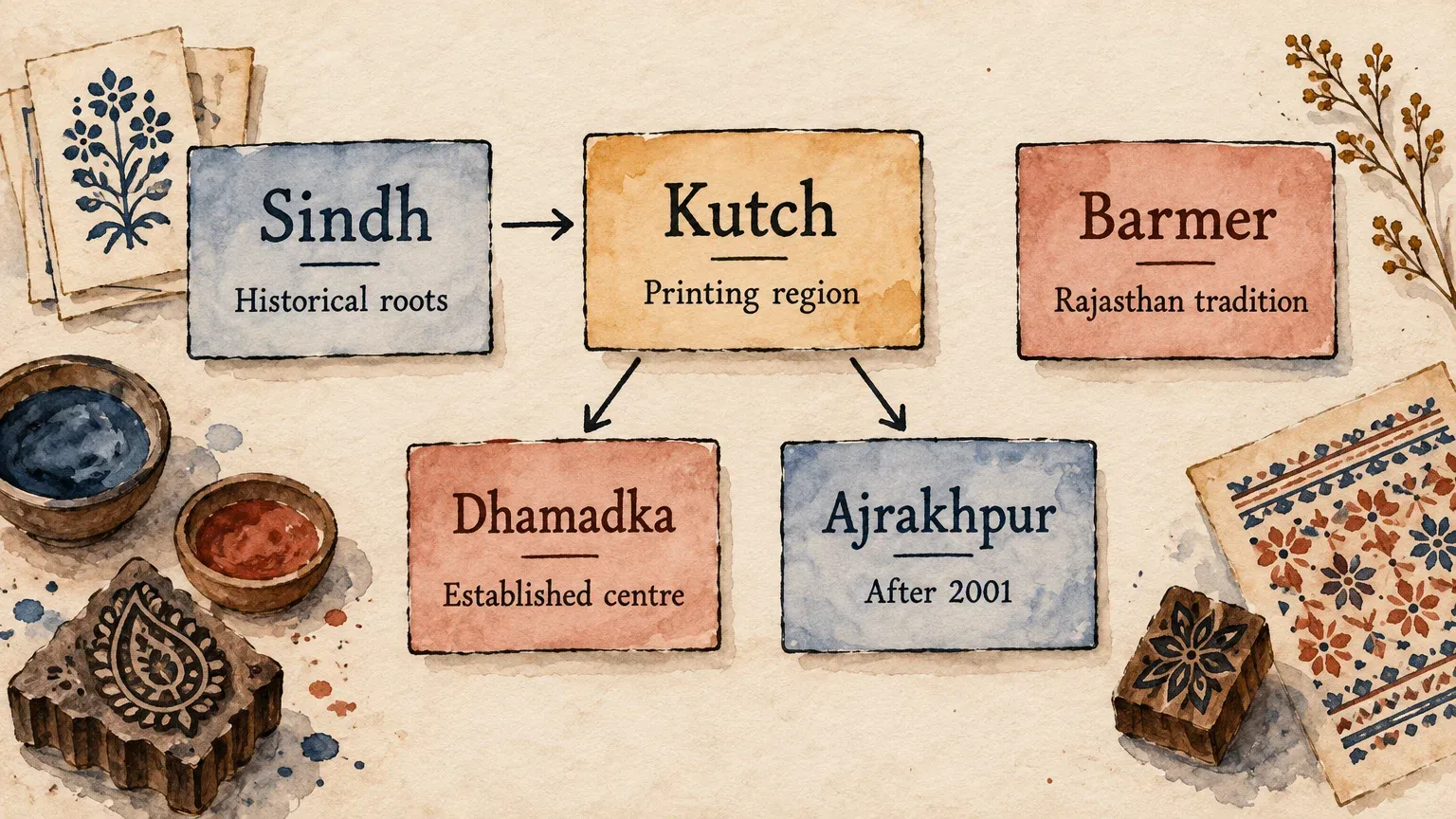
| Place | Present-day location | Historical or production role |
|---|---|---|
| Sindh | Pakistan | Generally identified as Ajrakh’s historical birthplace; continuing production region |
| Kutch | Gujarat, India | Region with established Khatri printing communities |
| Dhamadka | Kutch, Gujarat | Established centre in the craft’s water-dependent geography |
| Ajrakhpur | Kutch, Gujarat | Modern centre founded after 2001 |
| Barmer | Rajasthan, India | Practising Ajrakh tradition with Khatri artisans |
Khatri communities, migration histories and the historical timeline
Khatri printing families connect Sindh’s heritage with Kutch’s Ajrakh tradition. Their family histories preserve stories of migration and royal invitations.
Different accounts of the move to Kutch
The families tell different stories of when their ancestors moved to Kutch. Sharmila J. Dua records 1586 in a popular family legend, while Sufiyan Ismail Khatri’s account dates his ancestors’ invitation from Sindh by the King of Kutch to 1634.
Ancient motifs, surviving cloth and modern relocation
Ajrakh’s estimated 4,500-year history is linked to its proposed Indus Valley roots, according to D’Source. Bilgrami’s Ajrak study connects the trefoil on the Indus Valley Priest-King’s draped shawl with the pattern craftsmen call kakar, or cloud. This ancient visual connection sits alongside later surviving Ajrakh cloth and the migration histories of printing families.
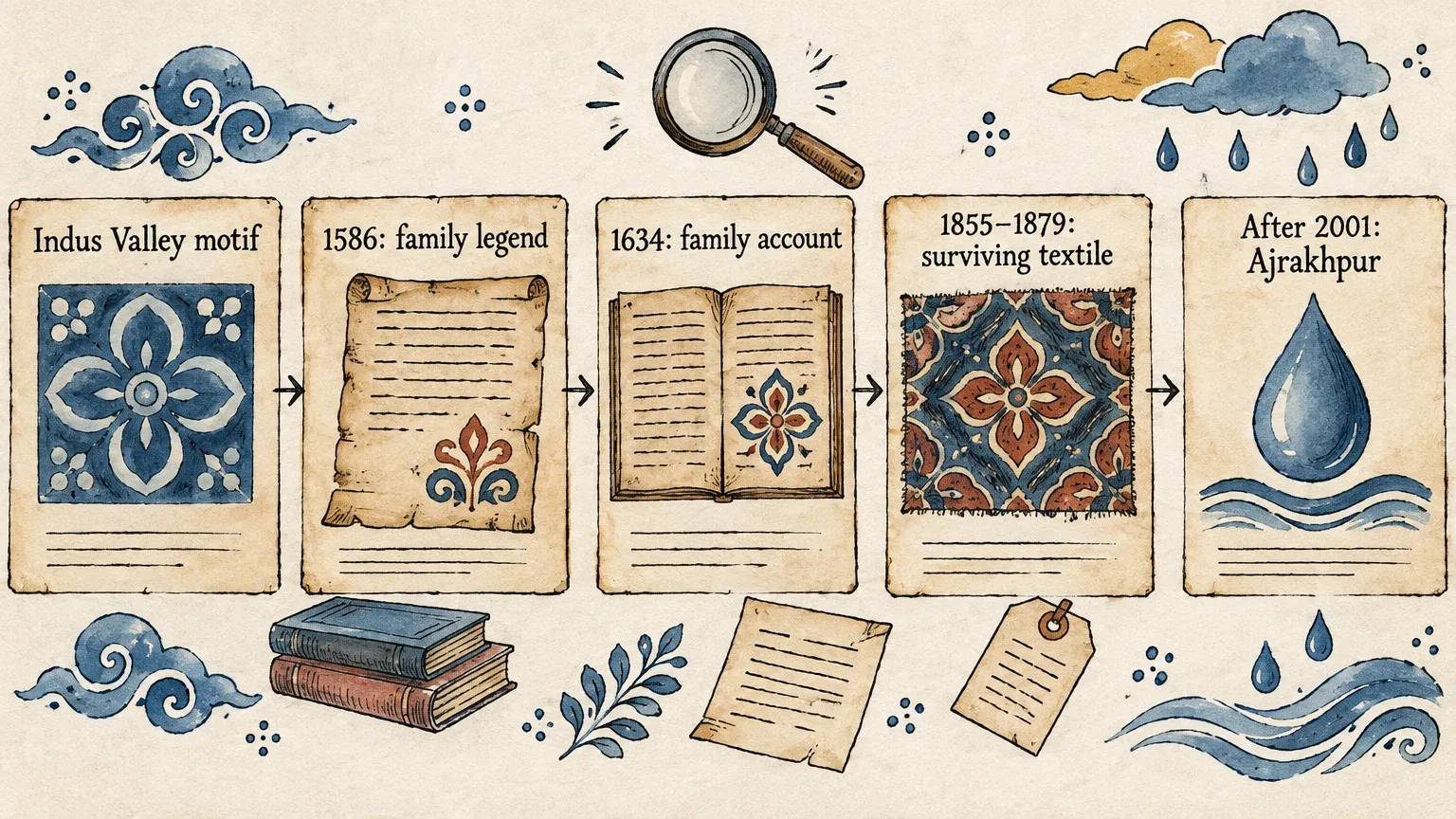
| Period or date | Connection to Ajrakh |
|---|---|
| Indus Valley period | Ancient visual connection between the Priest-King trefoil and Ajrakh’s cloud motif |
| 1586 | A family tradition’s beginning in a popular legend recorded by Sharmila J. Dua |
| 1634 | Royal invitation from Sindh in Sufiyan Ismail Khatri’s family account of migration |
| Approximately 1855–1879 | Surviving block-printed cotton Ajrakh from Sindh, a dated museum object recorded by the V&A’s textile account |
| After 2001 | Post-earthquake settlement development: Ajrakhpur founded in search of better-quality water |
| Historical trace | Connection to the craft |
|---|---|
| Trefoil motif | A visual and cultural connection with Ajrakh’s cloud pattern |
| Dated museum textile | Ajrakh cloth from a recorded place and period |
| Artisan family history | A community’s remembered migration history |
Water helps explain why Dhamadka and Ajrakhpur matter. Repeated washing and dyeing make water availability and quality central to printing. Khamir’s artisan accounts describe increased iron in water after the earthquake, which reduced work with natural dyes. The search for better water shaped Ajrakhpur’s emergence.
Barmer’s place in Rajasthan’s Ajrakh tradition
Barmer is Rajasthan’s Ajrakh centre, where Khatri printing communities keep the craft in practice, as described in the Crafts Museum’s Barmer documentation. These local printers give Rajasthan a living connection to the wider tradition.
Traditional use adds another dimension to this regional history. The Rhythm of Blues exhibition on Google Arts & Culture identifies Ajrakh as community clothing among Muslim pastoral groups, including Muslim Patels in Marwar and Maldharis in Kutch. If a garment is described as “Rajasthani Ajrakh”, ask for the specific printing location and maker to understand its provenance.
What does Ajrakh mean?
Arabic azraq or azrak, meaning blue, is the most commonly accepted explanation of “Ajrakh”, according to Impart’s Ajrakh account. Another popular story links it to aaj rakh, or “keep it today”. D’Source’s name discussion gives the phrase “Aaj ke din rakh”, meaning “Keep it for today”.
The traditional palette is indigo-blue, madder-red, black and white or the pale ground colour. Mushtak Khan’s Sahapedia colour account identifies red, blue, black and the ground; Khamir’s colour history connects Kutch’s natural-colour practice with indigo and madder. These colours help you recognise the tradition, but a modern garment’s dye details deserve a closer look.
What an Ajrakh label tells you about a garment
An Ajrakh label connects a garment to the craft; the maker, printing technique and production locations tell you more about how it was made. Once worn as community clothing, Ajrakh has also found a place in contemporary wardrobes. Jasleen Dhamija’s Sahapedia conversation recalls asking Mohammad Bhai to make saris.
When shopping, look for these four details:
- Maker: Who printed the cloth? Look for a named artisan or workshop.
- Printing location: Which village, town or cluster produced the Ajrakh fabric?
- Garment-making location: Where was it cut and stitched? The printing region and garment-making location may be different.
- Craft details: Which parts are Ajrakh-printed? Look for the printing technique, dyes, separate crafts and credited artisan labour.
Geometric repeats and the familiar palette are useful recognition clues, but similar-looking fabrics can be made differently. Sahapedia’s Ajrakh introduction describes traditional resist-dyed cloth printed on one or both sides. The V&A’s jacket record features a digitally printed Ajrak-inspired fabric. Look beyond the pattern to the printing process and the people behind it.
Location details help trace the craft to its makers. Craftmark’s artisan application asks for manufacturing addresses, clusters or villages and craftworker numbers.
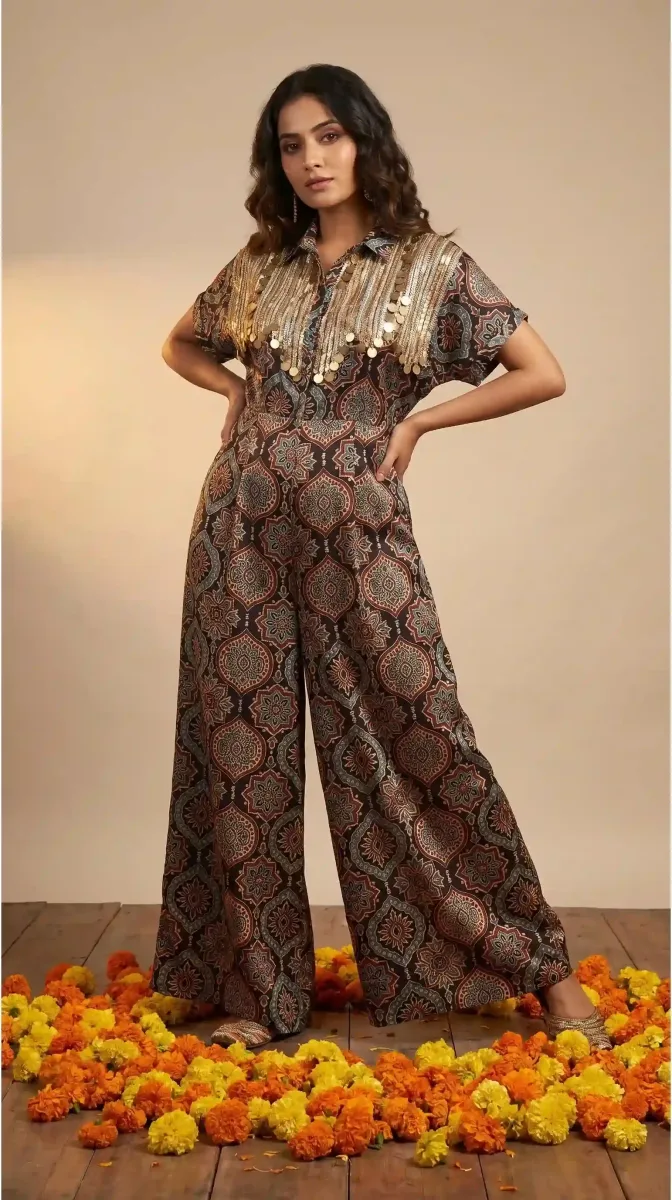
Our Black Ajrakh modal-silk jumpsuit credits Khatri Harun for Ajrakh, with Dhamadka / Ajrakhpur, Gujarat as its making region and 37–40 hours of artisan work. Our Blue Ajrakh bell-sleeve jumpsuit credits Irfan Khokar for mirror work. Its bodice and bell sleeves are made from Ajrakh-printed modal silk, while the bottom is modal silk. These details distinguish the printed fabric from the separate mirror-work craft and the construction of the finished garment.
Remember the roots; check the making details
Ajrakh’s regional history is part of its appeal, but a garment’s own story lies in who printed the cloth, where it was printed and who made the finished piece. Keep those questions close when choosing handcrafted clothing.
Explore our Ajrakh clothing and occasionwear with those questions in mind.