

Choose hand embroidery when a particular craft and artisan involvement matter; choose machine embroidery for repeatability, your preferred finish and value. Either can be well made: the National Qualification Register describes precision in hand stitching, while PSSCIVE’s machine-embroidery guidance requires design testing before production.
When buying, ask two questions: does the garment look and feel well made, and how was its embroidery produced? Assess the finish closely, then ask for production details specific to the garment.
Hand embroidery vs machine embroidery at a glance
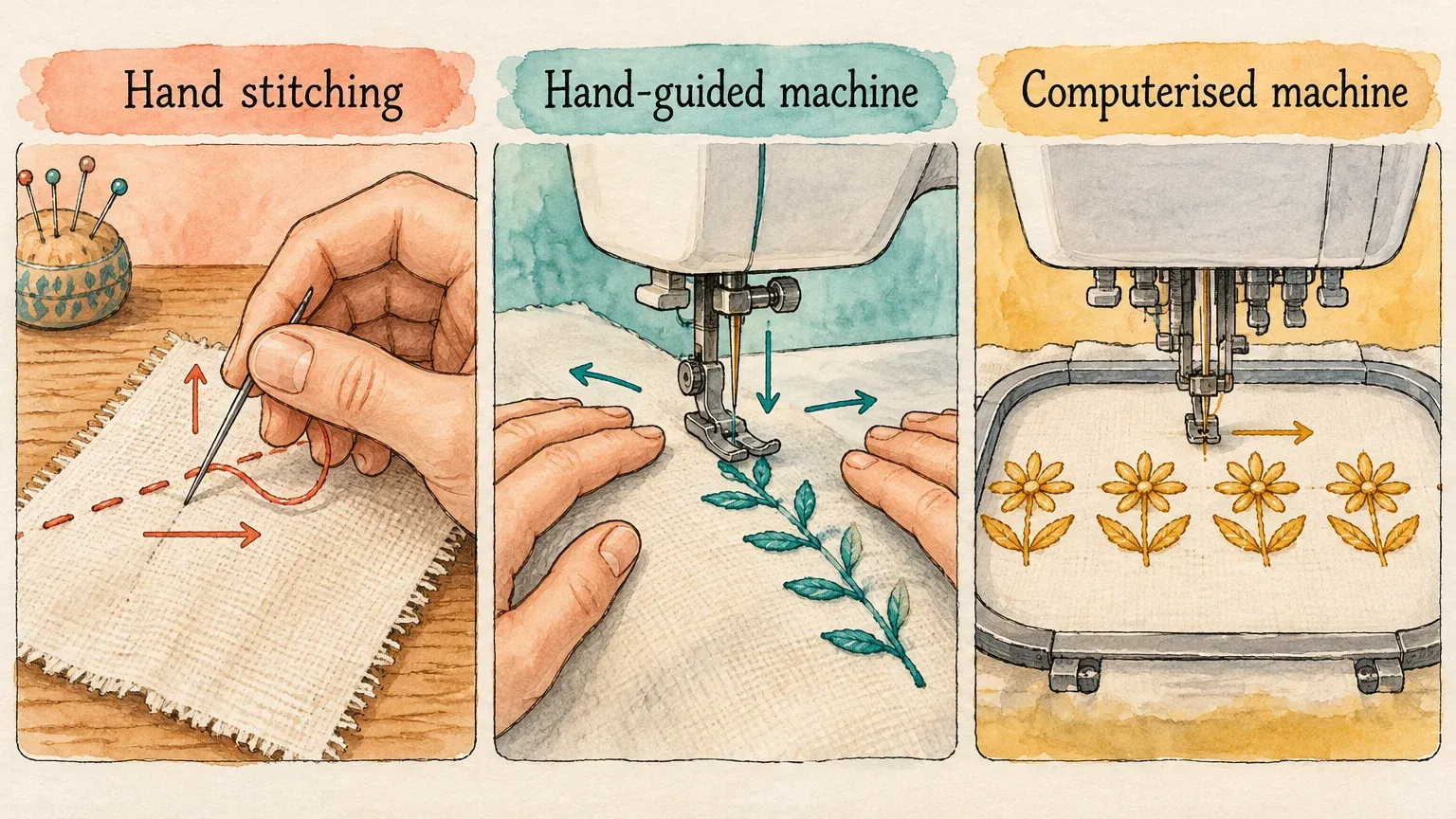
The main difference is how stitches are formed and controlled. In the NQR’s hand-embroiderer definition, the embroiderer works with needles and thread by hand. A machine forms stitches mechanically, with an operator guiding the fabric or a computerised design directing the stitching. PSSCIVE’s guidance covers operator-guided zigzag work, which involves active control.
| Factor | Hand embroidery | Machine embroidery |
|---|---|---|
| Production method | Embroiderer directly controls individual stitches | Machine forms stitches; operator or digital design guides execution |
| Repeatability and speed | Repeated motifs require stitch-by-stitch work | Prepared designs support faster repetition |
| Design flexibility | Direct adjustments during stitching | Changes through operator control or design preparation |
| Texture and shading | Individual variation is common; shading depends on direction, density and materials | Repeated designs are generally more consistent; shading also depends on direction, density and materials |
| Motif placement | Requires careful marking and alignment | Requires careful positioning and alignment |
| Finishing | Needs secure anchoring and tidy thread ends | Needs controlled tension, suitable support and tidy finishing |
| Price drivers | Skilled labour, technique, coverage and materials | Preparation, setup, quantity, complexity and materials |
| Care | Follow the complete garment’s instructions | Follow the complete garment’s instructions |
PSSCIVE’s operator textbook explains machine embroidery’s advantage in producing multiple copies quickly. Complex machine-worked garments can still require substantial preparation and skilled execution.
For the differences between craft names and production methods, see our Indian embroidery types guide.
Texture and repetition are clues, not proof of handwork
Handwork commonly shows individual stitch or motif variation, while a repeated machine design generally produces greater consistency. Skilled handwork can also be regular, and machines can imitate hand-worked effects: PSSCIVE describes machine-made Chikankari imitations, and Wilcom’s Hand Stitch effect varies stitch length, angle and count.
Texture and shading depend on thread, stitch direction, density and materials. Look at motif placement to judge composition and alignment, then ask how the stitches were formed.
| Observation | Possible interpretation | Follow-up question |
|---|---|---|
| Uneven stitches | Hand variation or uneven tension | Which stitch and production method were used? |
| Identical motifs | Consistent guides or repeat production | How were the repeats made, and which stages involved handwork? |
| Backing | Support for fabric and stitches | What backing remains inside, and how does it affect the finish? |
| Reverse-side threads | Bobbin-thread structure suggests machine stitching; knots and carries occur in handwork and other methods | Can you explain how this motif was made at each stage? |
| Raised embellishment | Dimensional stitches or added materials | Were these details attached by hand or machine? |
Hand embroidery should have a neat and tidy reverse, according to the HCSSC hand-embroidery handbook.
When shopping online, request sharp front and reverse photographs of the same motif, plus a wider view showing placement. If lining hides the reverse, ask for pre-lining photographs or process footage of the garment.
What you are paying for: labour, materials and repeat production
Hand-embroidered occasionwear often costs more because of the skilled stitch-by-stitch labour involved. To compare prices fairly, look at the whole garment and its materials.
NCERT’s hand-embroidery textbook identifies completion time as a costing factor and notes that metallic and silk embroidery threads cost more than cotton threadwork. Check these price drivers:
- Technique and complexity: intricate construction and difficult-to-reach areas can require more skilled work.
- Coverage: scattered motifs and densely embroidered panels involve different amounts of work.
- Materials: compare threads, beads, sequins and other embellishments.
- Preparation and quantity: machine work needs preparation, setup and sampling; repeat orders can spread those costs.
- Finishing: lining, tailoring and quality control contribute to the complete garment.
For a like-for-like comparison, place both listings side by side and match fabric, silhouette, motif size, embroidered area, embellishment materials, lining and finishing. Compare cuff-only work with cuff-only work, and sleeve coverage with sleeve coverage.
Judge the embroidery and finish rather than relying on price alone. Allow time for preparation, construction, fitting and finishing as well as embroidery when ordering for an occasion.
Quality, comfort and care: inspect the garment, not the label
Look for secure work, controlled tension, appropriate support and comfortable finishing, whichever method produced the embroidery. HCSSC’s handbook calls for even hand-stitch tension to prevent puckering; Madeira’s puckering guidance identifies correct tension and stabilisation as essential controls for machine embroidery.
Inspect the garment in good light, then try moving in it:
- Embellishments: check that beads and sequins are intact and securely attached. Do not pull them to test strength.
- Fabric: look for unintended puckering, distortion or stretched areas around motifs.
- Threads: notice loose loops and long tails that could catch on jewellery.
- Inside finish: feel for scratchy backing, exposed embroidery edges and uncomfortable skin contact.
- Lining: check that it covers contact points without pulling the outer fabric.
- Movement: sit, bend and raise your arms to assess stiffness, weight and motif placement.
Neither method has a universal durability advantage. Fabric, stitch structure, density, anchoring, materials and wear conditions affect longevity.
Follow the garment’s care instructions for its combination of fabric, threads and embellishments. GINETEX’s care-labelling principles explain that care labels identify treatments intended to avoid irreversible damage. Ask about snag repairs, replacement embellishments and suitable storage, particularly for metallic work. Avoid cutting a loose thread before checking whether it secures nearby stitching.
Ask the seller to name the craft and explain the process
Ask for the exact technique and how the selected piece was made, including what the seller means by “handcrafted”. These questions help you understand the work behind the garment:
- What is the exact embroidery technique?
- Which stages are hand-stitched, hand-guided machine-worked or computerised?
- Who does the handwork, what is their role and where is the embroidery made?
- What photographs, footage or production details can you share for this design or garment?
- Can you show a close-up and, where accessible, the reverse of the same motif?
- What are the care instructions, repair options and confirmed arrival date for my occasion?
A garment can combine methods, such as a machine-worked base with hand-worked accents. Combined embroidery is also recognised in the Women’s Institute exhibition guidance. Look for a clear explanation of each stage so you know what you are buying.
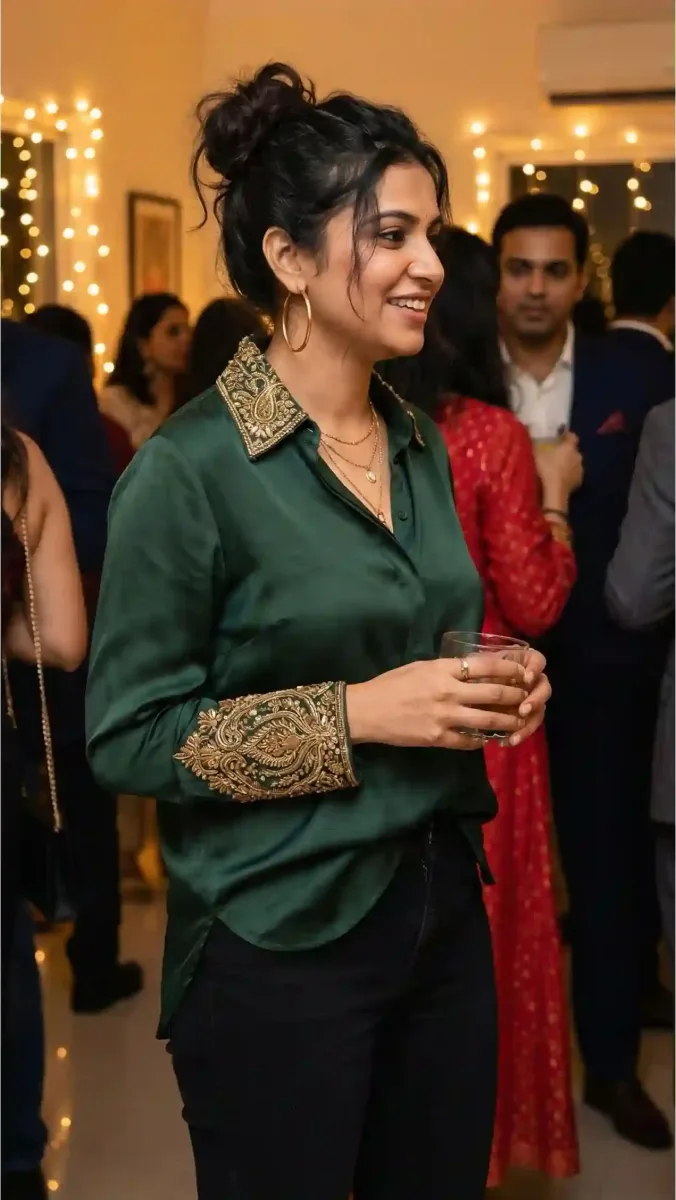
We name crafts specifically because each has its own character. Our Green Modal Silk Zardosi Work Shirt, priced at ₹7,750, features zardosi hand embroidery by Shambu Adhikary in Bhopal. It is dry clean only and made to order in 4–5 weeks. Confirm timing before ordering for a fixed event.
You can meet our embroidery artisans to learn about Shambu’s background: he is a third-generation artisan with 25 years of experience in zardosi, dabka and mirror work.
Choose handwork or machine work for your priorities
Let your occasion, taste and comfort guide the choice. Both hand and machine embroidery can suit everyday and occasion clothing; a clearly described combination can work just as well for your wardrobe.
- Everyday wear: prioritise comfortable weight, smooth skin contact and manageable care.
- Festive and wedding-guest wear: compare movement, lining, visual impact and budget. Machine embroidery can be occasion-worthy; handwork can be light.
- Bridal or investment clothing: choose handwork when a particular technique and artisan involvement matter. Ask about provenance, finishing and repair whichever method you select.
- Mixed-method clothing: choose it when you like the result and the seller clearly identifies the machine-worked and hand-worked stages.
Explore our handcrafted collections with your priorities for comfort, budget and occasion in mind.