

Lambani embroidery and mirror work overlap, but they are not interchangeable. Choose Lambani embroidery for the tradition, mirror work for reflective decoration, or a garment that combines both. D’source’s Lambani making process explains how mirrors form part of the embroidery; SEWA’s account of Ahir and Rabari embroidery places mirror work within both traditions.
Dastkari Haat Samiti’s fourteen-stitch inventory describes a repertoire, not a required count on every garment. Understanding the wider craft helps you read garment labels without treating a single decorative feature as the whole tradition.
Lambani embroidery vs mirror work at a glance
Lambani names a community-linked embroidery tradition; mirror work names a decorative technique. The distinction is between a wider craft identity and the use of reflective pieces within embroidery.
| What you are comparing | Lambani embroidery | Mirror work |
|---|---|---|
| Category and provenance | A tradition associated with Lambani communities | A technique used within several traditions |
| Technique | Varied stitches, sometimes combined with patchwork and mirrors | Reflective pieces secured within embroidery |
| Materials | Fabric, coloured thread and combinations of embellishments | Reflective pieces, thread and supporting fabric |
| Composition | Thread patterns, borders, geometry and embellishments considered together | Reflective accents within a wider design |
| Visual effect | Pattern, colour, texture and sometimes reflection | Light-catching highlights alongside stitching |
| Garment applications | Traditional clothing and contemporary silhouettes | Clothing across different craft traditions and silhouettes |
| What the label establishes | A claim about the embroidery tradition | The use of reflective decoration |
| Details to check separately | Maker, exact making location, weight, comfort and price | Community, maker, workmanship, weight and price |
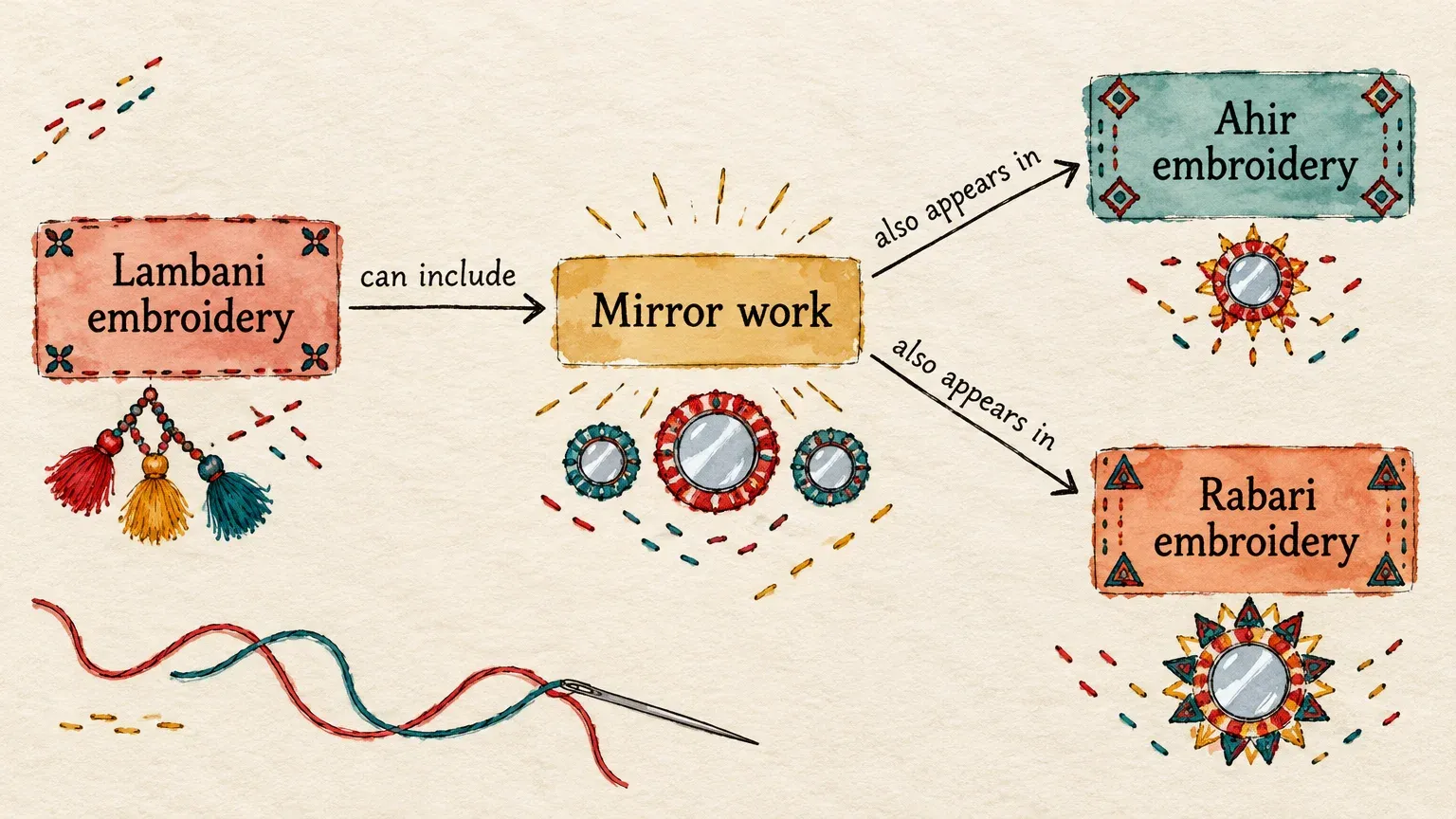
A useful way to read the labels: Lambani embroidery can include mirror work, while mirror work also appears in Ahir and Rabari embroidery.
For more on regional craft identities and individual techniques, explore our Indian embroidery types guide.
Lambani embroidery: community, stitches and the whole composition
Lambani embroidery carries knowledge passed between generations. Dastkari Haat Samiti describes young girls learning from their mothers, placing that shared knowledge at the heart of the craft.
The Ministry of Culture’s account of the Karnataka craft names Sandur, Keri Tanda, Mariyammanahalli, Kadirampur, Sitaram Tanda, Bijapur and Kamalapur.
The stitch repertoire in D’source’s introduction to Lambani embroidery comprises Bakkya, Bhuriya, Gadri, Jollya, Kans, Kaudi, Kilan, Maki, Nakra, Pote, Relo, Suryakanti Maki, Tera Dora and Vele. D’source also describes cross-stitch, overlaid and quilting stitches combined with appliqué-patchwork borders and mirrors.
Look beyond the mirrors to squares, circles, triangles and rectangles, alongside diagonal and parallel lines, all described by Dastkari Haat Samiti. These shapes and lines organise coloured thread into borders and patterned surfaces. Dastkari’s account of Lambani dress describes thread embroidery combined with chains, buttons, shells, sequins and dangling silver beads. Reflection is only one possible part of a much richer surface.
Not every Lambani garment needs mirrors. They are one component of the wider craft, rather than its defining requirement.
Traditional applications include lehenga, odhani and choli in D’source’s garment examples, while its Bijapur craft introduction describes embroidered long-skirt borders.
Mirror work beyond Lambani: Ahir and Rabari examples
Mirror work incorporates reflective pieces into a stitched design. Those pieces must be securely anchored: CBSE’s embroidery teaching material explains how structural stitches hold them in place. In D’source’s account of the Lambani making process, a mirror is stitched onto fabric before embroidery is worked around it.
Ahir and Rabari embroidery each has its own stitches and approach to mirror work, as SEWA explains. Its Ahir embroidery examples combine bright colours, dense motifs and varied mirror shapes.
SEWA’s Rabari chaakla examples are square household wall decorations embellished with embroidery and mirrors. These pieces extend mirror work’s applications beyond clothing.
“Gujarati mirror work” can be a useful browsing term. For a more precise description, ask for the maker’s name and community tradition.
One contemporary set can carry both labels
Our Blue Denim Lambani Tunic & Dhoti Set combines Lambani embroidery and mirror work. We credit Buriya for Lambani embroidery and Irfan Khokar for mirror work. The set is made in Bhuj, Gujarat.
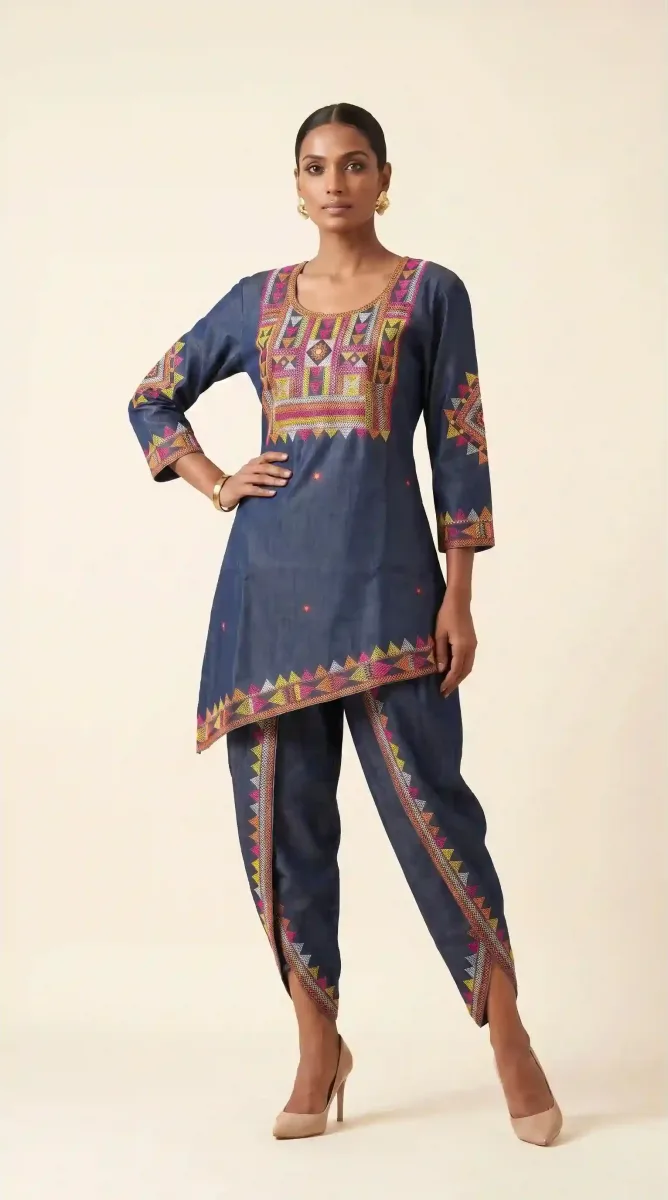
The set takes 66–73 artisan labour hours and costs ₹14,500. It uses 5 oz cotton denim and cotton lining, details worth considering alongside the embroidery when comparing garments.
Consider three aspects of the set:
- Reflective details: the light-catching mirror decoration.
- Embroidered composition: the geometric arrangement and its placement on the silhouette.
- Craft attribution: the makers’ names, their individual contributions and the making region.
Borders, necklines or yokes, and sleeves are useful places to examine a garment’s decoration. The tunic-and-dhoti silhouette brings traditional craft into contemporary occasionwear. Bhuj identifies where this set was produced, not the full geographical reach of Lambani embroidery.
What should a seller tell you about a garment?
A seller should explain the named craft, each maker’s contribution, the making region, materials and construction. Colours, motifs and mirror shapes help you understand the design; the maker’s account helps you understand its craft identity.
| Detail or label | What it tells you | What to request |
|---|---|---|
| Visible mirrors | Reflective decoration is present | Named technique and maker |
| Squares, triangles or parallel thread lines | A description of the composition | Evidence supporting the craft attribution |
| A Lambani label | The seller’s stated craft attribution | Who completed that work and their contribution |
| A named making region | The stated production location | Maker’s identity and contribution |
| Embroidery coverage | Where decoration appears | Fabric, lining, measurements and care instructions |
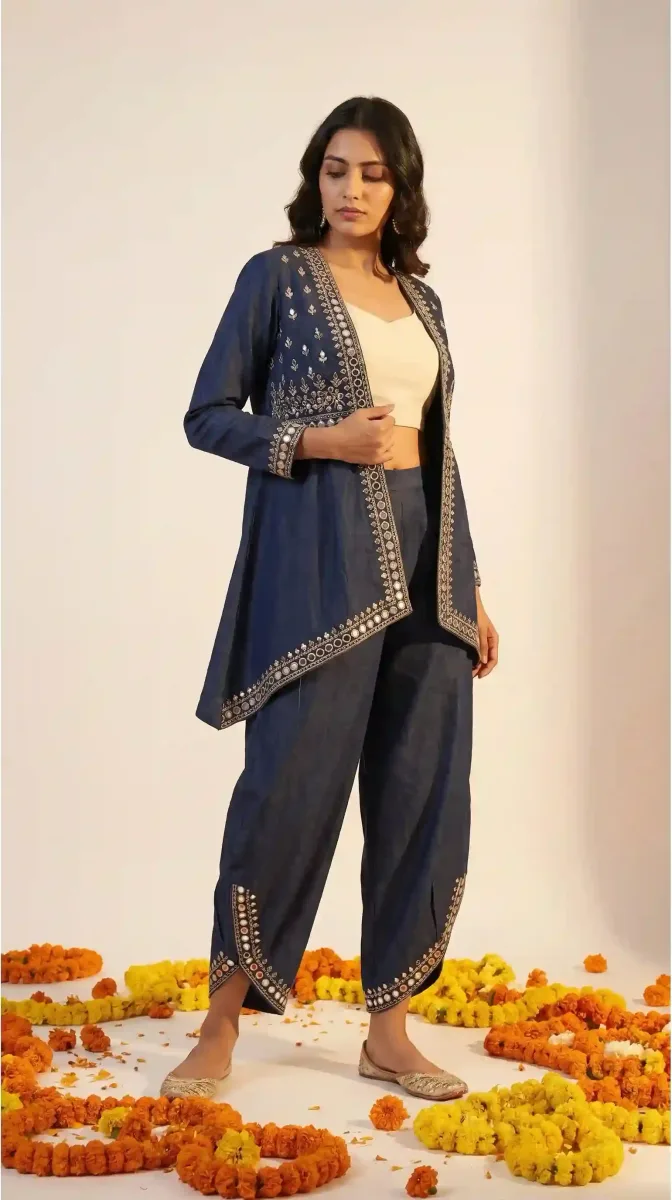
Our Blue Denim Jacket, Crop Top & Dhoti Set (Design I) features mirror work by Irfan Khokar in Bhuj, Gujarat. It takes 62–68 artisan labour hours, costs ₹13,500, and uses 5 oz cotton denim with cotton lining.
The jacket set’s reflective decoration adds light-catching detail, with its placement shaping the overall design of the contemporary ensemble.
If you are searching by city, Bhuj is a starting point. You can meet our embroidery artisans, including Irfan, a fourth-generation embroidery artisan with 31 years of experience.
Before buying:
- Ask how the mirrors are anchored and how the reverse or lining is finished.
- Check for loose threads or moving mirrors, and ask whether embellishments touch the skin.
- Compare fabric, lining, coverage and measurements when judging comfort and weight.
- Confirm care and timing. Both featured sets require dry cleaning and are made to order in 4–5 weeks. Confirm delivery separately if you are buying for a fixed event.
Choose the tradition, the reflective effect, or both
Let your priority lead: the tradition and maker’s story, reflective decoration, or both. For Lambani embroidery, look for a clear craft attribution and named maker rather than relying on mirrors alone.
Neither label automatically means heavier, more expensive or better made. Compare prices garment by garment, alongside materials, embroidery coverage and making time. For festive Indo-Western dressing, weigh up silhouette, placement, construction and maker details, then browse our mirror-work occasionwear with those preferences in mind.